Click For Schools

AI and robotics

21st Century Skills for Students (1)

21st Century Skills for Students: What Schools Must Teach Today

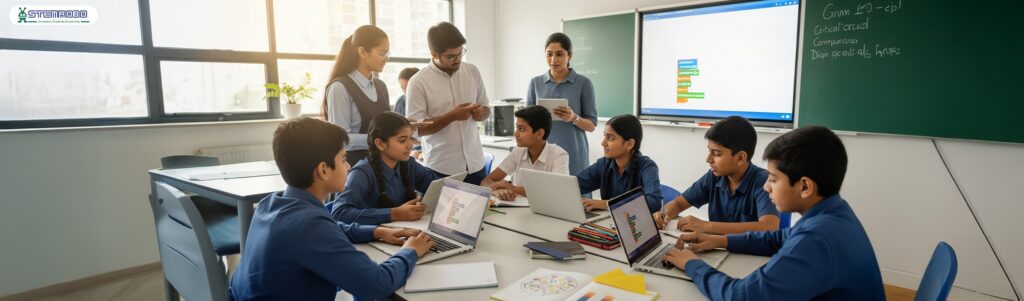
Students in contemporary classrooms maintain their traditional study methods which involve using textbooks and preparing for tests through memorization. The world outside school boundaries shows rapid advancement in technological development. Our daily existence depends on smart devices and artificial intelligence together with automation and robotics and virtual environments as essential components of our life. The increasing distance between traditional classroom teaching methods and actual workplace requirements needs educational institutions to concentrate their efforts on preparing students with essential 21st century skills. Students develop their ability to think independently and create new ideas while using these skills which help them handle different challenges and achieve success in upcoming technological workplaces. STEMROBO Technologies, a Educational Technology Company Platform for AI and Robotics Education, is now working with Indian schools to establish partnerships that create future-ready educational solutions. Why 21st Century Skills Matter More Than Marks Successful careers now require more than good grades as their sole requirement for achievement. Universities and employers today look beyond report cards. The assessment criteria require students to demonstrate their ability to analyze problems, think creatively, use technology, work with others, and learn new skills throughout their lives. The process of developing these abilities requires more than traditional memorization techniques and study methods that focus solely on exam preparation. The development of skills occurs when students conduct active research and practical application of their knowledge. The global education systems of today consider 21st-century skills to be essential components of their educational framework that needs to be taught to both students and teachers. Schools that emphasize these skills prepare learners not just to pass exams but to thrive in real life. Key 21st Century Skills Every Student Needs 1. Critical Thinking and Problem Solving Real-world problems lack ready-made solutions which students must learn to find. Students need to develop skills that allow them to observe situations, formulate important questions, examine data, and evaluate potential answers. The educational environment uses STEM labs and robotics labs along with design thinking spaces to create essential learning resources. Students develop their critical thinking abilities when they create functional models, control machines, and develop solutions to actual problems.  Learning transforms into social and practical activities that serve specific purposes instead of becoming abstract theoretical concepts. 2. Creativity and Innovation The 21st century now defines creativity as a skill which extends beyond artistic and musical expressions. The current definition of this term requires people to create intelligent solutions through their work on new projects while applying technology to realize their concepts.Through tinkering programs and innovation labs and Atal Tinkering Labs students receive opportunities to test their ideas through the process of experimentation and failure and subsequent learning and improvement.  The facilities enable people to develop original ideas which will lead to their success as entrepreneurs because they support the development of curiosity and risk-taking behavior. The right guidance helps students transform their natural curiosity into innovative solutions which build their confidence in their creative abilities and ideas. 3. Coding, AI, and Robotics Skills The modern world requires people to master coding because it operates as a basic life skill which people need for their daily activities. Early exposure to coding, artificial intelligence, and robotics helps students understand logic, structure, and computational thinking from a young age. Students acquire problem-solving skills through learning machine thinking and response patterns which show them contemporary technology functions. The educational system requires students to learn robotics and coding because these skills serve as fundamental instruments for their digital economy development. The main goal of technology education in schools is to teach students how to create new things while using technology for their own needs. The main goal of technology education in schools is to teach students how to create new things while using technology for their own needs. 4. AI, IoT, and Smart Technology Awareness Smart homes, smart cities, and connected devices have become common elements of contemporary existence. Schools need to implement AI and IoT educational programs through their regular academic programs to prepare students for the upcoming technological world. Students at Internet of Things laboratories study the operational principles which connect sensors with data management and automation and smart system functionality. Through hands-on projects, learners gain exposure to: Students acquire hands-on knowledge which enables them to link their academic work to actual world scenarios, consequently making their learning experience both relevant and future-oriented. AR & VR: Making Learning Come Alive The primary educational challenge today requires teachers to develop methods which successfully engage their students throughout the entire learning process. The combination of Augmented Reality and Virtual Reality creates a strong impact in this area. Students can learn about ancient civilizations through virtual walking experiences which allow them to see 3D human body structures and analyze advanced scientific principles through virtual exploration. The use of immersive technologies creates learning environments which provide students with interactive experiences that create lasting memories and thrilling educational moments. The combination of AR and VR technologies creates virtual classrooms which provide students with hands-on learning experiences that help them grasp challenging content through active participation instead of passive learning.  STEM Education: Building a Strong Foundation Theoretical aspects of science and engineering education receive practical application through STEM education. STEM education teaches students science, mathematics, and technology through practical problem-solving activities which combine these subjects into one educational approach. Students develop real-world skills through practical activities which show them actual applications of knowledge outside their textbooks. The program helps students build three essential skills for engineering, technology, and research careers which require technical abilities and research skills along with self-assurance in conducting experiments. Schools throughout India implement STEM-based learning systems to create solid academic foundations which equip students with essential skills needed for upcoming work environments. STEMROBO Technologies, which operates as a top STEM education organization in India, helps schools to create integrated learning spaces that promote student exploration and creative thinking while they acquire practical knowledge. Empowering Teachers for 21st Century Classrooms The most advanced technological systems will not function properly

21st Century Skills for Students: What Schools Must Teach Today Read More »
Platforms for AI and Robotics

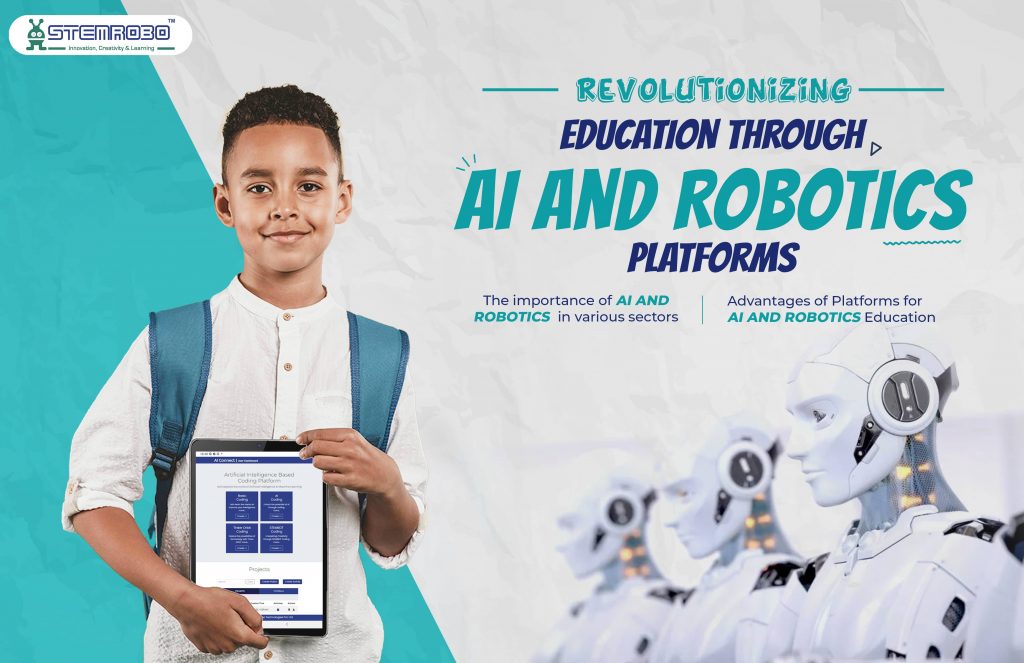
Revolutionizing Education through AI and Robotics platforms

In Today’s Tech-driven world, theoretical knowledge is insufficient for students to succeed in this quickly developing world. For Students, the importance of gaining knowledge related to technology is increasing and AI and Robotics are the most emerging fields among all. What is AI and Robotics? Robotics include studies related to the design of any robot through which children learn everything about electronic machines that we use in our day-to-day lives as well as in big industries. Through robotics, we learn how machines are made, their structure, design, and operation. Whereas AI (artificial intelligence) makes our machines work smartly. In simple words, AI teaches computers how to think and learn like humans. It helps computers to sense pictures, text, and sounds and provide results according to the given input. The importance of AI and Robotics in various sectors With the help of AI, machines have become automated, these automated machines take less time to complete any work as compared to humans and are also capable of giving more accurate results than humans. That’s why, Nowadays the importance of the human workforce is decreasing a lot. AI has developed so much that with its help we can now interact directly with technology. Communications systems like Alexa, Siri, and Google Assistant are AI-driven technologies. These technologies can listen to us, understand our communication, and respond to us. In the Education sector, AI and robotics play an important role in developing 21st-century skills such as Critical thinking, problem-solving skills, and communication skill among students. It also provides practical methods to understand complex concepts of STEM (Science, Technology, engineering, and mathematics) subjects. Advantages of Platforms for AI and Robotics Education There are many platforms for AI and Robotics that are designed for k-12 students, that provide them with the AI and robotics curriculum, resources, and an engaging platform to learn about these emerging fields. These Platforms for AI and Robotics education offer students a personalized learning environment where they can study according to their speed of learning and level of understanding of the concept. These Platforms for AI and Robotics education provide students with Hands-on training, With the help of this, children will understand the concepts better and this practical application will make the study more interesting for them. It also offers students educational resources such as tutorials, videos, and lesson plans that also provide a way for teachers to include AI and robotics into their curriculum and classroom activities. As we all know, nowadays there is a lot of demand in companies for those people who have knowledge about AI and robotics and have done projects related to it. So, if you want your children to succeed in the future workforce then provide them with practical knowledge by introducing them to platforms for AI and Robotics education. These platforms provide students with the opportunity to collaborate with others, share their ideas on different projects, learn how to communicate with others, and how to work in a team effectively. Importance of platforms for AI and Robotics in Schools AI and robotics make learning STEM subjects interesting and engaging as they involve project work and different group activities through which students get a chance to think creatively and apply their ideas to create something new. These Platforms for AI and Robotics also provide great help to teachers in enhancing their teaching methods. Through lessons and videos teachers can learn many other different types of ways to explain a particular topic. They may use different teaching methods according to the individual needs of the student. Students will enjoy learning through platforms for AI and Robotics as when children understand everything well, they feel motivated all the time. Integrating platforms for AI and robotics into school curriculam offers many benefits. These platforms engage students in hands-on, project-based learning, fostering interest and deeper understanding of STEM subjects. Through creativity and innovation, students deal with real-world problems, developing critical thinking skills and preparing for the 21st century. Interdisciplinary learning is promoted as students draw connections between different subjects. Using  platforms for learning Robotics and AI teachers also get the opportunity to enhance their teaching techniques and stay ahead in this technological world. For 21st century kids, who are different in each aspects and have interest in different subjects or skills, personalized learning experiences is very necessary and cater to individual student needs, fostering inclusivity and creativity. Altogether, these platforms enhance the educational experience and make learning interesting and easily accessible for each student enrich the educational experience, equipping students with essential skills and knowledge for future success.

Revolutionizing Education through AI and Robotics platforms Read More »

Robotics Lab for School Students

The Benefits of a Robotics Lab for School Students

Integration of technology has become important in the ever-changing educational sector as it promotes creativity and gets students ready for the employment of the future. Robotics is one of the most emerging fields that must be included in every school’s academic curriculum. In today’s tech-driven educational environment, there is an increasing need for students with technical abilities like robotics. Since robotics labs encourage hands-on learning, integrating them into classrooms is one method to support students’ educational journeys and get them ready for the employment market of the future. As it develops an excitement for learning about STEM (science, technology, engineering, and mathematics) subjects. Additionally, it makes their educational journey extremely interesting and filled with experiential learning. Hands-on learning Robotics labs are the platform that offers lots of opportunities for students to apply their creative ideas to real-world projects. Making these projects and involving in robotics activities, allows them to get an in-depth knowledge of any particular concept. By doing hands-on activities students will be able to retain the knowledge for a longer time and if the projects fail to work then they will be able to find their mistake at that time only and there they can also correct it. Fosters 21st-Century skills It develops 21st-century skills such as Critical thinking, logical reasoning, innovative and creative skills, communication skills, and teamwork. For example, when a student applies scientific ideas to a project, such as building a toy car, and if it doesn’t move, they can determine that there is a problem. It might be that the power source isn’t strong enough to drive the object, or the connections are incorrect. Thus, they will use their logical and critical thinking skills to solve this problem, which will also help them become more innovative thinkers and spark their curiosity in doing so. This will make their learning process engaging and make studying fun rather than boring because they will only be reading books. When students participate in these group activities, they can work together develop teamwork skills, and improve their communication skills. Additionally, when given project deadlines, they will learn time management skills. Finally, by working as a team, students can analyze each other’s performance and use this knowledge to improve themselves. STEMROBO is at the forefront of providing end-to-end solutions to K-12 students by integrating Robotics labs, STEM labs, AI, and many more labs. Our mission is to provide students with an interactive learning platform where students can practice Hands-on learning and develop their creative skills. Let us see how we accomplish this end-to-end solution approach. In addition to setting up these Robotics lab in many schools, we also give students access to a variety of kits that contain all the parts and equipment they could need for this hands-on learning experience. Along with this, we also provide teachers with a training program so they may learn how to utilize the labs and kits efficiently to improve student learning. Also, we organize national and international robotics competitions and offer workshops to students so they can first understand the significance of robotics labs for schools  and skills in their academic curriculum and second, understand the connection between theoretical knowledge and practical applications. Our lab for AI and robotics is a special place where students can explore the connections between these two revolutionary technologies. We provide schools with a comprehensive robotics and AI curriculum that gives students the information and abilities they need to succeed in the digital era. Our school robotics program is thoughtfully developed to meet the unique requirements of children at various stages while still following academic standards. We offer a dynamic learning environment where students may explore, collaborate, and invent through our student robotics lab. Our organization, AI and Robotics Lab in Schools is committed to utilizing innovative technologies to impact the field of education in the future. We think that robots and artificial intelligence (AI) have the potential to transform education and prepare students for the challenges of the future.

The Benefits of a Robotics Lab for School Students Read More »